
A Central Park Proverb
How can we build a "central park" in the digital epicenter of a society we live in?

Get wisdom.
That’s the instructions I find written in the book of Proverbs about how to live wisely.
In order to live wisely, I need to get wisdom.
Um, hello - isn’t that why I’m sitting here reading this in the first place? Is the concept of wisdom simply a mirage in the desert that appears only in a fragment of my imagination in my desperate search for guidance out of this arid wilderness?
So how doth one actually get wisdom in the first place?
______
My church recently did a sermon series on wisdom, and some of it was new information for me, but much of it was not.
That’s the thing, though. it may be something I’ve heard one hundred times before, but the real question is: what am I actually doing with what I’ve heard?
Wisdom is not the same thing as acquiring more knowledge or information to store in a large database for record keeping. Wisdom is what you do with that information.
You can read every book in the library and never let the words dive deep enough off the page to flow down from your brain to your heart: the control center of your life. How you actually apply knowledge to your everyday life is what makes wisdom, wisdom and not just more information; another book to read or another site to scroll.
Replaying my notes from my pastor:
Information fills your head, but wisdom shapes your life.
In this age of ever increasing TMI bombarding us at every angle of our every day on our social media feeds, work place inboxes, news channels, favorite AI chatbots, and maybe even your own family dinner tables- there’s only so much we can store in our “inboxes” until it all slips away after 2.5 seconds for the next bit of information to stimulate our ever decreasing attention spans.
So what are we doing with all this information aside from consuming it for entertainment, or to tickle our brains, or to stimulate interesting conversation.
Even if we applied every piece of advice we learned from our self-help book of a social media feed, we’d never be able to sustain it all mentally, emotionally, or even physically in the long run.
It comes down to filtering what is actually worthy of my time and attention to attempt to apply to my life?! Do I even have time to think about my time and what I’m giving my attention to?! It sort of begins to feel like a wild goose chase or catch 22…coming back to a mirage in the desert analogy.
Get wisdom.
But WHO do I actually get wisdom from?!
My Youtube guru?
My middle school math teacher?
My parents?
My friend who has a Cinderella Story and is now selling her steps to success in 5 payments of $499.99?
The reality is… you can learn and apply knowledge from any of these sources. And it may take you far. You may also find your own Cinderella Story following the same steps your friend charged you for.
But I keep coming back to the illustration my pastor shared:
“You may have the step by step directions, but if you have the wrong destination plugged into the GPS, it doesn’t matter how well you follow the instructions, you’re still going to end up at the wrong address”.
__________
I can’t help but think of wisdom like a tree planted in an urban cityscape.
A bright green tree housing little birds building their nests with a protective barrier around it to ensure that it can continue to keep growing even in this unfavorable landscape.
Across the street there is a large building being erected presumably to cram more creatures into this already concentrated concrete city.
Who knows how long this tree has been here- or how long it will remain?
But up until now it has been protected. And it adds LIFE to those who live, work and visit, whether they recognize its presence or not.


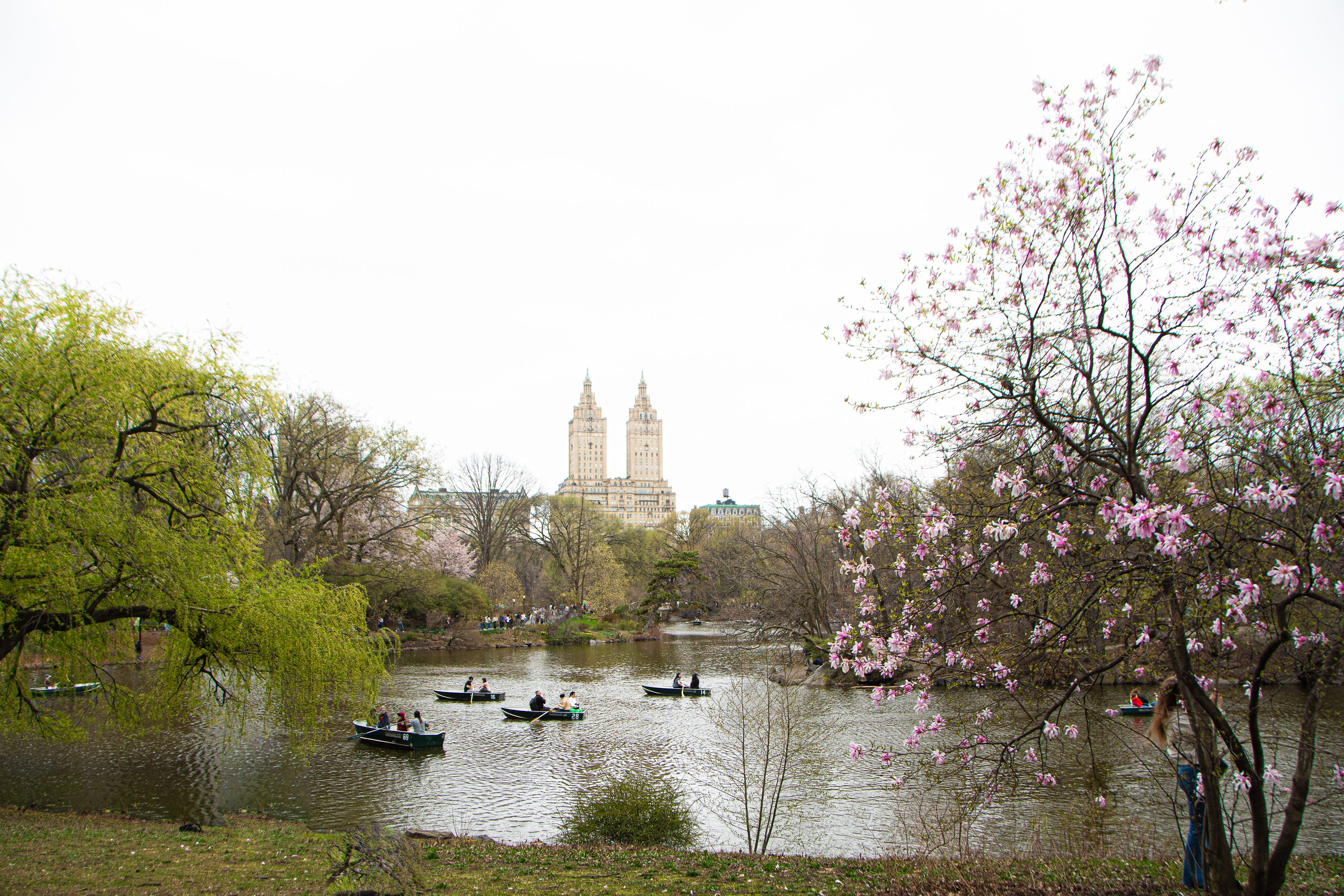
I think about the sea of city that New York City is….but smack in the middle of Manhattan is Central Park. I don’t know the scientific evidence or intentionality of the urban planners, but I am willing to bet that without preserving that large patch of green in the sea of city, I don’t think New Yorkers could survive very long.
Let me step into the digital library we call the world wide web:
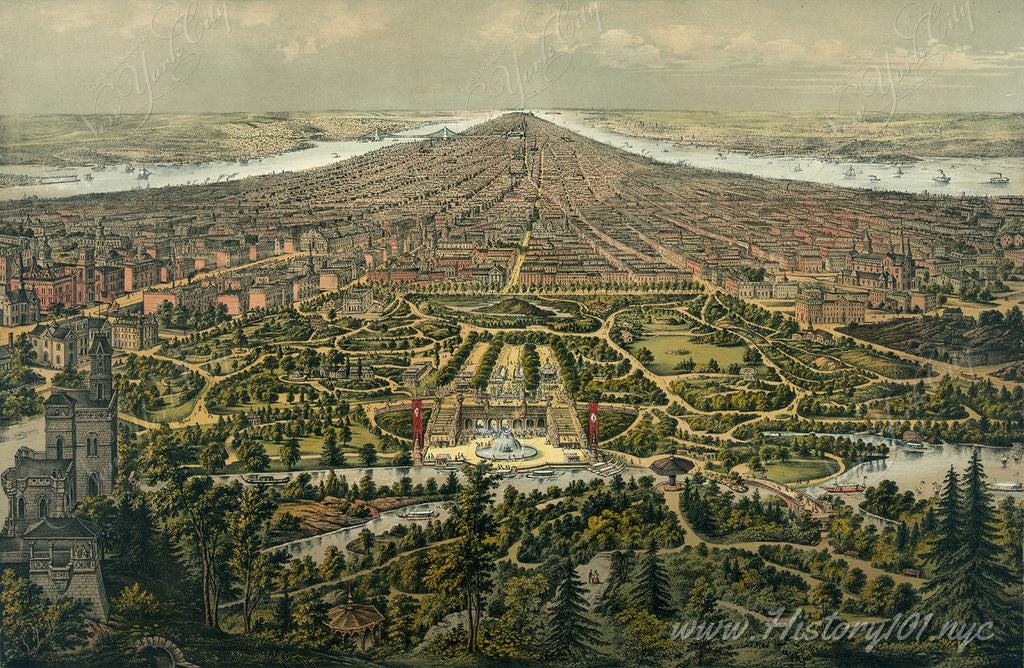
Here is an article called: History, Design and Philosophy Behind Central Park in New York City, which states:
Central Park is the product of a cultural shift in New York City in the late 1800s. The city began to question the quality of the environment that was developing.
At the time, industry, capitalism, efficiency, and progress were the priorities and drivers in New York society. Despite its zeal, groups of citizens sensed that the character and makeup of New York was becoming imbalanced as it reflected the overpowering presence of these industrial and capitalistic forces. The city was growing somewhat unconsciously, becoming increasingly unhealthy physically and mentally. Overcrowding, pollution, and improper disposal of human, animal, and industry waste was rampant. New Yorkers were disconnected from nature and deprived of fresh air and water. In addition, a growing chasm between social classes was evolving within the city. Uprisings and violence in France due to the exact circumstances raised eyebrows as an increasing concern among New York citizens.
The creation of Central Park can be seen as an attempt to counterbalance and return New York City’s urban environment and society to homeostasis. The city is an organism; like any organism, it sensed an imbalance and sought to recalibrate itself.
Why is it essential for us to recount the development of Central Park? It illustrates a moment of a city’s collective self-awareness, maturation, and growth. Before this, New York City was obsessed with its capitalistic and industrial tendencies, losing sight of its concern for humanity.
This brought about social unrest, death, class and racial separation, horrid living conditions, and cultural rot within the city. The fact that New York chose to take action to rebalance itself shows noteworthy collective growth. Just as an individual human grows and develops emotional awareness, New York City was collectively operating in the same way.
Social unrest.
Death.
Class and racial separation.
Horrid living conditions.
Cultural rot.
That is a picture of what life looks like without applying wisdom to it.
AHHH!
Let’s learn from central park urban landscape designers. Let’s get wisdom!
And where do we get wisdom from?
Well, the most wise man ever recorded in history wrote a book: it’s called Proverbs.
Proverbs was written by King Solomon who was the King of the nation of Israel during its Golden Era roughly around 970-931 BC. When he was just starting his rule over the kingdom as a youth, the living God of the universe, Yahweh, appeared to him in a dream, saying “Ask for whatever you want me to give you”. Solomon infamously replies with asking for wisdom to govern his people and to distinguish between right and wrong. Because he didn’t ask for riches for himself, long life, or vengeance on his enemies, the Lord was pleased and granted his request, and also decided to give him all those other things he didn’t even ask for. (1 Kings 3).
God gave Solomon wisdom and very great insight, and a breadth of understanding as measureless as the sand on the seashore. Solomon’s wisdom was greater than the wisdom of all the people of the East, and greater than all the wisdom of Egypt. He was wiser than anyone else, And his fame spread to all the surrounding nations. 32 He spoke three thousand proverbs and his songs numbered a thousand and five. He spoke about plant life, from the cedar of Lebanon to the hyssop that grows out of walls. He also spoke about animals and birds, reptiles and fish. From all nations people came to listen to Solomon’s wisdom, sent by all the kings of the world, who had heard of his wisdom.
[1 Kings 4:29-34]
Let’s crack open the first book within Solomon’s library:
The proverbs of Solomon son of David, king of Israel:
for gaining wisdom and instruction;
for understanding words of insight;
for receiving instruction in prudent behavior,
doing what is right and just and fair;
for giving prudence to those who are simple,
knowledge and discretion to the young—
let the wise listen and add to their learning,
and let the discerning get guidance—
for understanding proverbs and parables,
the sayings and riddles of the wise.
The fear of the Lord is the beginning of knowledge,
but fools despise wisdom and instruction.
Proverbs 1:1-7
So the wisest man recorded in history says, where we find wisdom is the FEAR OF THE LORD.
This is not the “ahh God is so scary!” kind of fear of the Lord. It’s more like “WOW the author and creator of the universe is living and dwelling among us and HE is the source of life. He created life and He knows a thing or two about how to live life. Maybe I should listen to what He has to say.”
The Lord by wisdom founded the earth; by understanding he established the heavens.” - Prov 3:16-19
The king of the greatest kingdom on earth at the time in history was able to recognize that his source of wisdom, power, authority, wealthy, beauty, understanding…all came from the creator of it all.
In a human-driven culture like New York City, the thought of even believing in a higher power source beyond oneself is a radical concept.
But the Proverb of Central Park tells us of something beyond what industry, capitalism, efficiency and progress tell us. These alone will ultimately lead to our decay.
So what kind of central park do we need to build in the 21st century? How do we stop the “brain rot” of where our culture is headed?
I don’t have the answer, all I can offer is that it all starts with:
Get Wisdom.



Powerful